ISLAMABAD: Pakistan’s top civil and military leadership on Thursday agreed on a unified national strategy to address mounting energy, economic and security challenges stemming from the ongoing Middle East crisis and global oil market volatility.
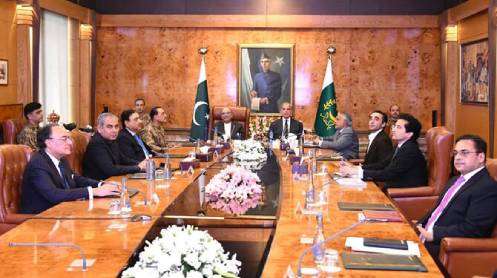
A high-level consultative meeting chaired by President Asif Ali Zardari at Aiwan-e-Sadr was attended by Prime Minister Shehbaz Sharif, Chief of Army Staff Field Marshal Syed Asim Munir, Deputy Prime Minister/Foreign Minister Ishaq Dar, and other senior cabinet members and officials.
The meeting reviewed the impact of rising global oil and gas prices on Pakistan’s economy, with a focus on managing inflation, ensuring energy security and maintaining fiscal discipline. Officials briefed participants on measures to stabilise petroleum prices and cushion the broader economic impact.
Participants emphasised the need for coordinated policymaking across economic management, energy planning, food security and national security. The leadership also called for public awareness campaigns to reduce fuel consumption and promote public transport and ride-sharing to ease pressure on energy demand.
The broader regional security situation was also discussed, with officials stressing the importance of national consensus and enhanced institutional coordination to navigate emerging geopolitical challenges.
Meanwhile, Pakistan continues to play an active diplomatic role in promoting regional stability. Foreign Office officials confirmed that indirect talks between the United States and Iran are underway, with Pakistan facilitating communication as part of a broader peace process involving key regional stakeholders.
In a significant development, a senior Pakistani official revealed that Israel withdrew Iranian Foreign Minister Abbas Araghchi and Parliament Speaker Mohammad Bagher Qalibaf from its potential target list after Pakistan urged Washington to avoid escalation, highlighting Islamabad’s behind-the-scenes diplomatic engagement.
On the security front, operations under “Operation Gazab Lil-Haq” have resumed following a temporary pause during Eidul Fitr, with authorities reiterating their commitment to countering terrorist threats and safeguarding national security.
Separately, Prime Minister Shehbaz Sharif reaffirmed Pakistan’s commitment to advancing CPEC 2.0 during a meeting with the Chinese ambassador, focusing on agriculture, industrial cooperation and infrastructure development.
In another diplomatic engagement, the prime minister briefed Malaysian Prime Minister Anwar Ibrahim on Pakistan’s ongoing efforts to facilitate dialogue and de-escalation in the Middle East.
The leadership reiterated that Pakistan will continue to pursue a balanced approach—strengthening economic resilience, ensuring energy security and promoting peace through proactive diplomacy amid an increasingly uncertain global environment.
Story by Asim Yasin & Mariana Baabar & Ag Reuters & Ag App